
Jesse’s Intent
by Paul Gelsinger
From Guinea Pig Zero #8
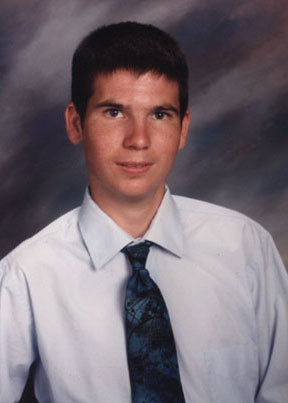
Born on June 18, 1981, Jesse Gelsinger was a real character in a lot of ways. Not having picked out a name for him prior to his birth, the name Jesse came to us three days later. When considering a middle name, we pondered James but decided that just Jesse was enough for this kid. His infancy was pretty normal. With a brother 13 months his senior he was not overly spoiled. He crawled and walked at the appropriate ages. When he started talking, it quickly became obvious that this was one kid that would speak his mind and crack everybody up at the same time. He nursed until he was nearly two years old. It wasn’t until Jesse was about two years and eight months old that his metabolic disorder reared its ugly head. Jesse had always been a very picky eater. Since weaning, he would more and more refuse to eat meat and dairy products, focusing instead on potatoes and cereals. After the birth of his sister in late January 1984 and following a mild cold in early March 1984, Jesse’s behavior became very erratic over a brief period of time. Since his mother had previously experienced schizophrenic behavior, I was very concerned that Jesse was exhibiting signs of psychoses. His speech was very belligerent, as if possessed. My wife, Pattie, and I took him to see our family doctor. Thinking that Jesse was anemic because of his poor diet and lethargy, he put Jesse on a high protein diet. It turns out that that was the worst thing for Jesse. Forcing him to eat peanut butter sandwiches, bacon, and to drink milk over the next two days overwhelmed Jesse’s system
On a Saturday in mid-March 1984, Jesse awoke, parked himself in front of the television to watch cartoons and promptly fell back asleep. When we were unable to rouse him, we became alarmed. His mother called the doctor and insisted that we be allowed to take Jesse to Children’s Hospital of Philadelphia, just across the Delaware River from our home near Woodbury, NJ. Upon arrival at CHOP, Jesse was admitted through the emergency room in what they called a first stage coma. He responded to stimuli but would not awaken. After several tests indicated high blood ammonia, the doctor told us that Jesse most probably had Reye’s syndrome, which upset us very much. Several hours later they indicated that other tests indicated that this was not Reye’s and that they would need to run more tests to determine what was wrong with Jesse. Within a week we had the diagnosis of ornithine transcarbamylase deficiency syndrome. OTC, we were told, was a very rare metabolic disorder. Jesse’s form of the disorder was considered mild and could be controlled by medication and diet.
And so, after eleven days in the hospital, Jesse came home and we hawked everything he ate and made certain he took his medications. From there on Jesse progressed fairly normally, although small for his age. It wasn’t until he was age ten that he would need to be hospitalized again for his disorder. Following a weekend of too much protein intake, Jesse’s system was unable to rid itself of the ammonia buildup fast enough and he again slipped into a coma. His specialist scrambled to understand how to get him well again, not ever actually having had to treat hyperammonemia. Within five days, Jesse was again well enough to go home, having suffered no apparent neurological damage.
As Jesse entered his teenage years he resisted taking his medications. He felt that he could control his disorder and only took his meds when he didn’t feel well. His mother and I had divorced in 1989, two years after our move to Tucson, AZ. Jesse was under my care after obtaining custody of my four children in 1990. At age sixteen Jesse was now taking nearly fifty pills a day to control his illness. Having remarried in 1992, my new wife, Mickie, and I kept a careful watch on Jesse but as he grew older we expected him to take more care of himself. With six children between us we had much to consider. Jesse was being seen at a state funded metabolic clinic in Tucson twice a year to monitor his development and, while not always compliant, he was progressing into adulthood
In September 1998, Jesse and I were made aware by his specialist of a clinical trial being done at the University of Pennsylvania in Philadelphia. They were working on what he described as gene therapy for Jesse’s disorder. We were instantly interested, but Jesse needed to be an adult, so he was told that he could not participate until age eighteen. That same fall Jesse was stressing his metabolism, as he had never done before. Having recently acquired a part time job and an off-road motorcycle, I saw little of Jesse. As a senior in high school, Jesse had a very busy schedule. Unknown to me at the time, Jesse was having symptoms of his disorder but was trying to hide them. He didn’t want restrictions placed on him due to his disorder. I knew that he was inconsistent taking his medications because I rarely had to order them. I spoke with him every other week about his need to take better care of himself. It took him nearly dying to wake him up
On December 22, 1998, I arrived home in mid-afternoon to find Jesse curled up on the couch. A close friend was with him. Jesse was very frightened. He was vomiting uncontrollably and could not hold down his medications. After about five minutes with him, I determined that I could not manage his recovery. I convinced his pediatrician and specialist that Jesse needed to be hospitalized and placed on intravenous fluids. With his ammonia levels at six times normal, Jesse was in trouble. After no significant changes in his condition by Dec. 24th, the hospital let Jesse go home for Christmas. Listless all day, Jesse crashed Christmas night and was admitted to intensive care where they discovered hypoglycemia, seriously low blood sugar. His specialist felt certain that it was due to one of his medications, l-arginine, and discontinued it. He also decided that Jesse’s primary medication, sodium benzoate, was not effective enough and ordered that a newer better medication be provided
Jesse recovered well enough to be placed in a regular room at the hospital but his ammonia levels refused to drop. I was staying in the hospital at Jesse’s side day and night. Two days after Christmas, on a Sunday afternoon, Jesse and I had a conversation about how he was doing. I described to Jess how it seemed that he was stuck up a tree, not knowing whether he was going to climb down or fall out. I went home to be with the rest of my family and sleep in my own bed for one night. Jess called me at about 11:00 PM and said, “Dad, I fell out of the tree”. He was again vomiting uncontrollably. I rushed back to the hospital and spent a heartrending two days trying to help my son through his crisis. On Monday, I discovered that the insurance company was balking at paying for Jesse’s new medications and that they had not been shipped. I told the pharmacist to purchase the new medications ($3300 for one month’s supply) with my credit card and that I would deal with the insurance company later. The insurance company relented at that point and authorized the medications and they were ordered on Tuesday. By Tuesday afternoon, Dec. 29, Jesse was so listless that I grew very alarmed that he would not get well.
At 5:00 PM Jesse’s vomiting returned and he was becoming incoherent. I moved into the hall to get help. There I found his pediatrician examining his chart. I summoned him to his room and while he called in the intensive care doctor, I called my wife and told her to come immediately. Jesse’s aunt and grandmother arrived for a visit only to find Jesse in a crisis. Mickie arrived and together we held Jesse while they prepared a bed for him in intensive care. The intensive care doctor, seeing Jesse’s deteriorating condition and believing Jesse always mentally impaired, inquired if life support would be appropriate. It was then that I realized that these people had not known Jesse well, and I explained that the loss of mental faculties that they were seeing was not Jesse’s normal state at all. Jesse developed tremors and began to vomit. Suddenly he just stopped. I whispered to Mickie, “He’s still breathing, isn’t he?” I asked Jesse’s pediatrician to check him. After placing his stethoscope on Jesse’s chest for a few moments he looked to the nurse present and told her to call a code blue. We were whisked from the room, while they intubated and manually ventilated Jesse and took him to intensive care. We were distraught, believing Jesse to be near death. After fifteen minutes they indicated that they were getting him under control, that his heart never stopped.
For two days Jesse lingered in an induced coma to allow the ventilator to control his breathing. He weighed in at only ninety-seven pounds, down from his healthy weight of one hundred twenty pounds. His old medication only partially lowered his ammonia level. On Thursday morning Jesse’s new medications arrived. Through a gastrointestinal feed, they gave Jesse a special nutritional formula containing his new medications. Within twenty-four hours, Jesse’s ammonia levels started falling. We waited at his side as he began to regain consciousness. His first conscious act was to motion us to change the television station? Jesse was back. Within a day Jesse was out of intensive care with ammonia levels at normal levels, something he had never known his entire life. He was ordering and eating food like a teenager? again something he had never experienced. We were ecstatic. When his specialist came to see him, I shook his hand and told him that he had a medical miracle on his hands. A week after nearly dying Jesse was back in school full time with a newfound zeal for life.
By early February 1999 Jesse had recovered enough strength to consider returning to work but he came down with a serious case of influenza. Because illness often triggered Jesse’s metabolic disorder, I stayed home to keep an eye on his condition. Jesse was kind enough to pass the bug on to me. It was the sickest I’d been in twenty years with fever for six days and fatigue for four weeks. Jesse recovered within a week and was back in school. I had him tested twice while he was ill and his ammonia level only slightly elevated? the new meds were working wonderfully.
Near the end of February Jesse returned to his part-time job as a courtesy clerk at a supermarket three miles from our home. On Saturday the 27th he called me at 11:00 p.m. for a ride home. I picked him up in my work van and on the way home we had a fateful conversation. I had been asking Jesse to find out if his job would offer him medical insurance once he graduated from school in May. Being a very typical teenager, he had done nothing to inquire and I told him in no uncertain terms that he needed medical insurance if he didn’t intend to continue his education. At the time we believed that Jesse would not be covered under our insurance once he left school. Jesse rarely raged at his illness but this time he flung a half-full bottle of soda against my windshield while cursing his disorder. In anger I gave him a backhand punch to the shoulder and chastised him. Only two blocks from home Jesse in anger flung open the door and told me he was jumping out. I said “Whoa, wait until I stop.” As I was coming to a stop he gave me a look like he was jumping and went out the door. All I could envision was Jesse falling under the van and me running him over. Sure enough, even though I had nearly stopped, he fell. As I stopped I could hear him screaming that I was on his arm. Now, my van is a work van loaded with tools and weighing six thousand pounds. Thinking “Oh God, No!” I threw the van in park and raced around the back of the van to find Jesse’s right arm and elbow pinned under my right rear tire. Making certain that his body was clear; I rolled the van forward off his arm. The kid was crying in agony. As I cradled him in my arms, I cried, “You idiot, what were you thinking” and then “Jesse, I’m sorry.” Begging me not to move him, I knew he would need an ambulance. His arm was a red mess from wrist to upper arm with the elbow area gouged out. The tire print was evident on the underside of his arm. As I began to think about seeking help, a woman who had witnessed what happened while driving from the other direction asked if she could help. I told her to please call 911 and she drove off to do so. A neighbor, hearing the commotion, came out and offered his help. Another passerby offered me his cell phone and I called my wife. Within minutes the paramedics arrived, strapped Jesse to a gurney and whisked him off to the hospital. After the police informed me that I had done no wrong, that I could not control his actions, it was all I could do to drive the one block left to home. I had been there to help Jesse through his near-death experience in December and through a serious bout with the flu only to nearly end his life in an accident.
Shaking and emotional, my wife, Mickie, drove me to the hospital. Jesse was okay; he hadn’t even broken his arm! While suffering extensive road rash and a serious wound to his elbow he recovered full use of his arm following two days in the hospital and a month of physical therapy. I was an emotional wreck for a week following the accident. This kid was something else. His sister told him that if he caused me to have a heart attack she was going to kill him. A month later I got word from our insurance company regarding Jesse’s status if he did not continue his education. He was covered until age twenty-five as long as he remained our dependent. I joked with him that I had run him over for nothing. He was proud of his war wound with dad. God, what a relief to see this kid bounce back again.
In early April 1999, Jesse again had an appointment at the metabolic clinic. While there, the subject of gene therapy and the clinical trial at the University of Pennsylvania came up again. Jesse and I were both still very interested. I informed the doctor that we were already planning a trip to New Jersey in late June, that Jesse would be eighteen at that time and to let Penn know we were interested. I received a letter from Penn in late April firming things up. By late May our visit was set. We would fly in on June 18th and he would be tested on the 22nd. Jesse was none too happy about flying in on the 18th; that was his birthday and he wanted to party with his friends. A few days later he told me it was okay to fly on his birthday. I told him that it was a good thing since I had already bought the tickets for all six of us a month earlier
So on Friday, June 18, 1999, Jesse with his three siblings, PJ (age 19), Mary (15), and Anne (14), and Mickie and I boarded a plane to take us down a path we never imagined. We had a party for Jesse that night at my brother’s house. We had a reunion with ten of my fifteen siblings and extended families that Sunday. It was great to see everyone. The kids got to meet cousins they hadn’t seen in twelve years. Jesse’s cousins nicknamed him Captain Kirk for the way he struck the volleyball with a two-handed chop. This was turning into a great vacation. We hung out on Monday and on Tuesday, June 22nd, we all headed over to Philly to meet with the clinical trial people. We arrived a few minutes late because of a wrong turn on the expressway only to discover that they weren’t ready for us. The nurse in charge rounded up Dr. Raper and after a 45-minute wait we were all ushered into a hospital room to go over consent forms and discuss the procedures that Jesse would undergo. Dr. Raper described the technique that would be used: Jesse would be sedated and two catheters would be placed into his liver; one in the hepatic artery at the inlet to the liver to inject the viral vector and another to monitor the blood exiting the liver to assure that the vector was all being absorbed by the liver. He explained the dangers associated with this and that Jesse would need to remain immobile for about eight hours after the infusion to minimize the risk of a clot breaking free from the infusion site. Dr. Raper also explained that Jesse would get flu-like symptoms for a few days. He briefly explained that there was a remote possibility of contracting hepatitis. When I questioned him on this, he explained that hepatitis was just an inflammation of the liver and that the liver was a remarkable organ, the only organ in the body with the ability to regenerate itself. In reading the consent form, I noticed the possibility of a liver transplant being required if the hepatitis progressed. The hepatitis seemed such a rare possibility and the need for transplant even more remote that no more alarms went off in my head. Dr. Raper proceeded to the next phase and what appeared the most dangerous aspect of the testing. A needle biopsy was to be performed of Jesse’s liver one week after the infusion. Numbers explaining the risks of uncontrolled side effects were included. There was a one in ten thousand chance that Jesse could die of the biopsy! I said to Jesse that he needed to read and understand what he was getting into, that this was serious stuff. The risks seemed very remote but also very real. Still one in ten thousand weren’t bad odds in my mind. There would be no benefit to Jesse, Dr. Raper explained. Even if the genes worked the effect would be transient because the body’s immune system would attack and kill the virus over a four-to-six-week period.
After our forty-five-minute conversation with Dr. Raper ended, Jesse consented to undergo the five-hour N15 ammonia study to determine his level of enzyme efficiency. Many vials of blood were taken before Jesse drank a small vial of N15 ammonia. This special isotope of ammonia would then show up in Jesse’s blood and urine. The rate at which it was processed out of the body would determine Jesse’s efficiency. Going into this study we were aware that Jesse’s efficiency was only 6% of that of a normal person. After waiting with Jesse for two hours we all decided to head out to Pat’s Steaks for lunch and tour South Street for a few hours. On our return to the hospital, Jesse was done and ready to go. It was now mid-afternoon and we decided to see the Betsy Ross house and Independence Mall. After checking out the Liberty Bell, the kids wanted to see the Rocky statue, so we headed over to the Art Museum. Four of us, Jesse, PJ, Mary and me, raced up the steps Rocky style (we had watched the movie the night before). Finding only Rocky’s footsteps, we learned that the statue had been moved to the Spectrum. So, we headed over to Pattison Avenue. A Phillies’ game was about to start so I stayed in our rented Durango while the kids had their pictures taken by Mickie. It was a fun time for everyone, especially Jesse. He was starting to feel good about what he was doing. This was his thing and he had a chance to help. The following day we toured New York City. Everybody got to pick a place to visit. Jesse chose FAO Schwartz toy store where he bought four Pro Wrestling action Figures. We all had a great day finishing with the Empire State Building and the Staten Island Ferry.
Four weeks later, back in Tucson, we received a letter addressed to Mr. Paul Gelsinger and Jesse. It was from Dr. Mark Batshaw confirming Jesse’s 6% efficiency of OTC and stating that they would like to have Jesse in their study. I presented the letter to Jesse and asked him if he still wanted to do this. He hesitated about a moment and said yes. Dr. Batshaw called about a week later to follow-up his letter and spoke to Jesse briefly. Jesse told him that he would need to call back and talk to me and explain everything. Jesse was deferring to me to understand this and Dr. Batshaw was well aware of that. When I spoke to Dr. Batshaw we discussed a number of things. Since they had forgotten to include the graph showing Jesse’s N15 results he faxed it to us. I asked if Jesse was the least efficient patient in the study. Dr. Batshaw explained that he was. Dr. Batshaw steered the conversation to the results they had experienced to date. He explained that they had shown that the treatment had worked temporarily in mice, even preventing death in mice exposed to lethal injection of ammonia. He then explained that the most recent patient had shown a 50% increase in her ability to excrete ammonia following gene therapy. My reaction was to say, “Wow Mark! This really works. So, with Jesse at 6% efficiency you may be able to show exactly how well this works.” His response was that that was their hope and that it would be for these kids. He explained that there were another 25 liver disorders that could be treated with same technique and that overall these disorders affected about one in every 500 people. I did some quick math and figured that’s 500,000 people in the U.S.A. alone, 12,000,000 worldwide. I dropped my guard. Dr. Batshaw and I never discussed the dangerous side of this work. When I presented to Jesse what Mark Batshaw had to say he knew the right thing to do? he signed on to help everybody and, hopefully, himself in the long run. The plan was for him to be the last patient tested and was tentatively scheduled for mid-October.
So, by late July 1999 Jesse had a new focus for his life but he had other priorities also. He had just gotten a tattoo on the back of his right calf. Of course, he didn’t discuss it with me first and had used the money he owed me to get it done. I had just bought him a used street motorcycle as a graduation present and he was getting his driver’s license, which he obtained on August 21. It was so great to see him grinning ear to ear as he drove drive off on his bike for the first time. We saw little of Jesse over the next two weeks. If he wasn’t working, he was out riding with his buddy, Gar, or spending the night at a friend’s house. He was still living at home and paying $35 a week for rent and $15 a week to pay back for the bike insurance that we had fronted for him. This kid was really living and we were so proud of him.
In mid-August we heard from Penn that they were having trouble scheduling their next patient and were wondering if Jesse would be available in September. I explained that I would have to check with him. He okayed it and arranged to take an unpaid leave of absence. Most communications with Penn were done via e-mail at this point. The finalized date of admission would be September 9, 1999. I wanted to go with Jesse, but being self-employed and not seeing any great danger, I scheduled to fly in for what I had perceived as the most dangerous aspect of the testing, the liver biopsy. I would fly in on the 18th and return with Jesse on the 21st.
As September 9th approached we all became more and more focused on Jesse’s trip. Mickie bought him some new clothes, Jesse assembled his pro wrestling, Sylvester Stallone, and Adam Sandler videos and I worked like a dog to get as much done as possible in preparation for my own departure. So with one bag of videos and another with clothing, Jesse and I headed off to the airport early on Thursday, the 9th. He was both apprehensive and excited. He had to change planes in Phoenix and hail a cab for the hospital once he arrived in Philly. Jesse had never been away from Tucson on his own prior to this trip. Words cannot express how proud I was of this kid. Just eighteen, he was going off to help the world. As I walked him to his gate, I gave him a big hug and as I looked him in the eye, I told him he was my hero. As I drove off to work, I thought of him and what he was doing. I started considering how to get him some recognition. Little did I know what effect this kid was going to have.
Jesse called us that night using his phone card. He was well, had a little mix-up with the cabbie about which hospital to take him to. The cabbie was cool about it though, he said. Reminded him of a scary version of James Earl Jones. Jesse was to have more N15 testing the following day and again on Sunday before the actual gene infusion on Monday, September 13. Saturday was an off day and he would be able to leave the hospital. Two of my brothers had arranged to visit with Jess and that had put me at ease about not going. Jess had a blast with his uncle and cousins on Saturday and a good visit with his other uncle and aunt on Sunday. Mickie and I spoke with Jesse every day and his spirits were good. He was apprehensive on Sunday evening. Dr. Raper had put him on intravenous medications because his ammonia was elevated. I reasoned with him that these guys knew what they were doing, that they knew more about OTC than anybody on the planet. I didn’t talk with the doctors; it was late.
I received a call from Dr. Raper on Monday just after they infused Jesse. He explained that everything went well and that Jesse would return to his room in a few hours. I discussed the infusion and how the vector did its job. Dr. Raper didn’t like the word invade when I explained what I thought the virus did to the liver cells. He explained that if they could affect about one percent of Jesse’s cells, that they would get the results they desired. Mickie and I spoke with Jesse later that evening. He had the expected fever and was not feeling well. I told Jesse to hang in there, that I loved him. He responded, “I love you too, dad.” Mickie got the same kind of goodbye. Little did we know it was our last.
I awoke very early Tuesday morning and went to work. I received a mid-morning call from Steve Raper asking if Jesse had a history of jaundice. I told him not since he was first born. He explained that Jesse was jaundiced and a bit disoriented. I said, “That’s a liver function, isn’t it?” He replied that it was and that they would keep me posted. I was alarmed and worried. My ex-wife, Pattie, happened to call about twenty minutes later and I told her what was going on and she reminded me that Jesse had jaundice for three weeks at birth. I called Penn back with that information and got somebody who was apparently typing every word I said. That seemed very unusual to me. I didn’t hear from the doctors again until mid-afternoon. Dr. Mark Batshaw called and said Jesse’s condition was worsening, that his blood ammonia was rising and that he was in trouble. When I asked if I should get on a plane, he said to wait, that they were running another test. He called back an hour and a half later and Jesse ammonia had doubled to 250 micromoles per deciliter. I told him I was on a plane and would be there in the morning.
It’s a very helpless feeling knowing your kid is in serious trouble and you are a continent away. My plane was delayed out of Tucson but got into Philly at 8:00 a.m. Arriving at the hospital at 8:30 a.m. I immediately went to find Jesse. As I entered thru the double doors into surgical intensive care I noted a lot of activity in the first room I passed. I waited at the nurse’s station for perhaps a minute before announcing who I was. Immediately, Drs. Batshaw and Raper approached me and asked to talk to me in a private conference room. They explained that Jesse was on a ventilator and in a coma, that his ammonia had peaked at 393 micromoles per deciliter (that’s at least ten times a normal reading) and that they were just completing dialysis and had his level down under 70. They explained that he was having a blood-clotting problem and that because he was breathing above the ventilator and hyperventilating his blood ph was too high. They wanted to induce a deeper coma to allow the ventilator to breath for him. I gave my ok and went in to see my son. After dressing in scrubs, gloves and a mask because of the isolation requirement I tried to see if I could rouse my boy. Not a twitch, nothing. I was very worried, especially when the neurologist expressed her concern at the way his eyes were downcast? not a good sign, she said. When the intensivist told me that the clotting problem was going to be a real battle, I grew even more concerned. I called and talked to my wife, crying and afraid for Jesse. It was at least as bad as the previous December, only this time they had been in his liver. I would keep her posted.
They got Jesse’s breathing under control and his blood ph returned to normal. The clotting disorder was described as improving and Dr. Batshaw returned to Washington, D.C. by mid-afternoon. I started relaxing, believing Jesse’s condition to be improving. My brother and his wife arrived at the hospital around 5:30 p.m. and we went out to dinner. When I returned I found Jesse in a different intensive care ward. As I sat watching his monitors I noted his oxygen content dropping. The nurse saw me noticing and asked me to wait outside, explaining that the doctors were returning to examine Jesse. At 10:30 p.m. Dr. Raper explained to me that Jesse’s lungs were failing, that they were unable to oxygenate his blood even on 100% oxygen. I said: “Whoa, don’t you have some sort of artificial lung.” He thought about it for a moment and said yes, that he would need to call in the specialist to see if Jesse was a candidate. I told him to get on it. I called my wife and told her to get on a plane immediately. At 1:00 a.m. the specialist, Dr. Shapiro, and Dr. Raper indicated that Jesse had about a 10% chance of survival on his own and 50% with the artificial lung, the ECMO unit. Hooking up the unit would involve inserting a large catheter into the jugular to get a large enough blood supply. I said, “50% is better than 10, let’s do it.” It seemed like forever for them to even get the ECMO unit ready. Jesse’s oxygen level was crashing. At 3:00 a.m. as they were about to hook Jesse up, Dr. Shapiro rushed into the waiting room to tell me that Jesse was in crisis and rushed back to work on him. The next few hours were really tough. I didn’t know anything. Anguish, despair, every emotion imaginable went through me. At 5:00 a.m. Dr. Shapiro came to see me and said they had the ECMO working but that they had a major leak, that Dr. Raper had his finger on the leak. I quipped that I was a bit of a plumber; maybe that’s what they needed. Shapiro returned to work on Jesse and I began to worry for my wife. Hurricane Floyd had made landfall in North Carolina at 3:00 a.m. and was heading toward Philly. At 7:00 a.m. I entered through the disabled double doors into the intensive care area and after noting four people still working on Jesse and another half dozen observing, approached the nurses station to get them to see if my wife would get in ok. They agreed to check and asked if I would like a chaplain. I’m a pretty tough guy, but it was time for spiritual help. They at first sent a young woman who I think was Jewish. I guess she felt a bit out of place since I am Christian and another chaplain, a man a few years younger than me and a Christian, was called in to help me. At this point I was trying to contact my family, my mother to get emotional support. A hospital staffer was very helpful in that respect.
By mid-morning six of my siblings with their spouses had arrived. Mickie’s plane just got in before they closed the airport and she arrived by taxi at the hospital. We weren’t able to see Jesse until after noon. Dr. Batshaw was stuck on a train disabled by the hurricane. Drs. Raper and Shapiro described Jesse’s condition as very grave; that whatever reaction his body was having would have to subside before he could recover. His lungs were severely damaged and if he survived it would be a very lengthy recovery. They had needed to use more than ten units of blood in hooking him up. When we finally got to see Jesse, he was bloated beyond recognition. The only way to be sure it was Jesse was the battle scar with his dad on his elbow and the tattoo on his right calf. My siblings were shaken to the core. Mickie touched him ever so gently and lovingly, our hearts nearly breaking.
With the hurricane closing in and threatening to close the bridges home, my siblings left by late afternoon. My sister and her husband stayed to take us to dinner and drive us exhausted to our hotel. After sleeping for an hour, I arose and felt compelled to return to see Jesse. Leaving Mickie a note I walked the half-mile back to the hospital in a light rain. Hurricane Floyd had skirted Philly and was heading out to sea. I found Jesse’s condition no better. I noted blood in his urine. I thought, “How can anybody survive this?!” I said a quiet goodbye to Jesse and returned to the hotel at about 11:30 p.m. I found Mickie preparing to join me. I described Jesse’s condition as no different and returned to bed. Mickie went out walking for a couple hours.
In the morning we arrived at 8:00 a.m. at Jesse’s room. A new nurse indicated that the doctors wished to speak to us in an hour or so about why they should continue with their efforts. We went to have breakfast at the hospital cafeteria. I knew and told Mickie we should be prepared for a funeral. She wanted to believe he would get well. Drs. Batshaw and Raper were there when we returned. They told us that Jesse had suffered irreparable brain damage and that his vital organs were all shutting down. They wanted to shut off life support. They left us alone for a few minutes and we collapsed into each other. On their return, I told them that I wanted to bring my family in and have a brief service for Jesse prior to ending his life. Then I told them that they would be doing a complete autopsy to determine why Jesse had died, that this should not have happened. While waiting for my siblings, moments of anger toward the doctors would sweep over me. I would say to myself, “No, they couldn’t have seen this.” I went so far as to tell Dr. Batshaw that I didn’t blame them, that I would never file a lawsuit. Little did I know what they really knew.
Seven of my siblings and their spouses and one of my nieces were present for the brief ceremony for Jesse? more for us at this point. I had all the monitors shut off in his room. Leaning over Jesse, I turned and declared to everyone present that Jesse was a hero. After the chaplain’s final prayer, I signaled the doctors. Dr. Shapiro clamped off Jesse’s blood flow to the ECMO machine and shut off the ventilator. After the longest minute of my life, Dr. Raper stepped in and I removed my hand from Jesse’s chest. After listening with a stethoscope for a moment he said, “Goodbye, Jesse, we’ll figure this out.” Not a dry eye all around. This kid died about as pure as it gets. I was humbled beyond words. My kid had just shown me what it was really all about. I still feel that way.
I supported these doctors for months, believing that their intent was nearly as pure as Jesse’s. Even after the media started exposing the flaws in their work I continued to support them. I had discovered that federal oversight was woefully inadequate, that many researchers were not reporting adverse reactions and that the FDA was being influenced into inaction by industry. I decided to attend the RAC meeting in December where all the experts were to discuss my son’s death. It wasn’t until that three-day meeting that I discovered that there was never any efficacy in humans. I had believed this was working based on my conversations with Mark Batshaw and that is why I defended Penn for so long. These men could not go in front of their peers at the RAC meeting in Bethesda and say this was working. After Penn and the FDA made their presentations on Dec. 9, I asked for a lunch meeting with the FDA, NIH and the Penn doctors. After touching on many issues I let them all know that I had not to this point even spoken to a lawyer, but would be in the near future. Too many mistakes had been made and unfortunately, because of our litigious society, it was the only way to correct these problems.
There is so much more to Jesse’s story. I can’t help but believe that they will kill this with time and money, as they always seem able to do. Who is “they”? They are heartless and soulless industry and their lobbying efforts; they are the politicians more interested in placating industry than in protecting the people, they are doctors so blinded in their quest for recognition that they can’t even see the dangers anymore. Let them apply Jesse’s intent to their efforts, and then they’ll get it right.
 Guinea Pig Zero